
What running out of supplies costs your business

Most workplace supplies are easy to ignore while they’re on the shelf. The cost becomes clear when the shelf is empty.
The printer stops before a client’s meeting. The shipping station runs out of tape during the afternoon pickup window. The breakroom has no cups before a staff event. Someone drops their planned work, searches for the item, asks around, places an urgent order, or drives to a store.
The business pays for all of it.
The missing item is the smallest part of the bill

A supply shortage creates several costs at once.
• Employees wait, change tasks, or build a workaround.
• An office manager or buyer spends time finding the item.
• A rush order may carry a higher unit price or delivery charge.
• Finance has another receipt, invoice, or reimbursement to process.
• The replacement may come from an unapproved vendor or fall outside the normal purchasing process.
The purchase price is visible. The labor around the purchase often disappears into the workday.
That hidden labor can cost more than the product.
Consider a hypothetical paper shortage. Four employees each lose 20 minutes while a print job is delayed. Their loaded labor cost is $35 per hour. That interruption costs $46.67. An administrator spends another 45 minutes locating paper and arranging pickup at a loaded cost of $32 per hour. Add $24 in labor and a $25 delivery or travel expense. The shortage has now cost $95.67 before the business pays for the paper.
Use your own wages, time, and fees. The point isn’t the example total. It’s the set of costs that belongs in the calculation.
Small interruptions spread across the team
One empty shelf can affect more people than the employee who finds it.
When the toner runs out, a colleague may walk to another floor to print. A receptionist may answer questions about where backup stock is kept. An IT employee may be asked to check on a printer that has no technical problem. A manager may need to approve an off-cycle purchase.
Each interruption looks minor on its own. Together, they break concentration and delay work that customers, students, patients, or other employees are waiting for.
Some shortages can stop the process. Shipping labels, first-aid products, restroom supplies, and cleaning products support daily operations. Running out can delay a pickup, close a space, or force staff to use a poor substitute.
Emergency buying weakens purchasing control
Urgent purchases leave little time to compare the right options. The person solving the problem may choose the closest product instead of the approved product. They may pay a retail price, use a personal card, or create a one-time vendor record.
That choice adds work for the people who approve, code, and reconcile the expense. It can also make purchasing data harder to read. A team reviewing its normal account may miss emergency purchases scattered across card statements and reimbursements.
The shortage can repeat because full demand never appears in one place.
Workarounds have their own price
Employees are good at keeping work moving. That can hide a supply problem.
They borrow from another department. They buy a small pack on the way to work. They switch to a product that doesn’t fit the dispenser or equipment. They keep extra stock at their desks because they don’t trust the supply room.
Those fixes create duplicate inventory and uneven access. One department may have six months of stock while another runs out. Buyers see less of what the organization owns, uses, and needs.
A quick fix can become the reason the same shortage happens again.
Calculate the cost of your last shortage
Use this worksheet the next time a supply runs out:
employees affected x minutes lost / 60 x loaded hourly cost
Then add:
• Time spent searching, ordering, driving, receiving, and distributing
• Rush delivery, mileage, or pickup costs
• Any difference between the emergency price and your contracted price
• Time spent approving and reconciling the purchase
• Lost output, missed service windows, or delayed work you can value with confidence
Keep estimates conservative. Even a low estimate gives you a better picture than the item price alone.
Review several shortages over a quarter. Repeated problems will point to the products and locations that need a better stocking plan.
Set a reorder point before the shelf is empty
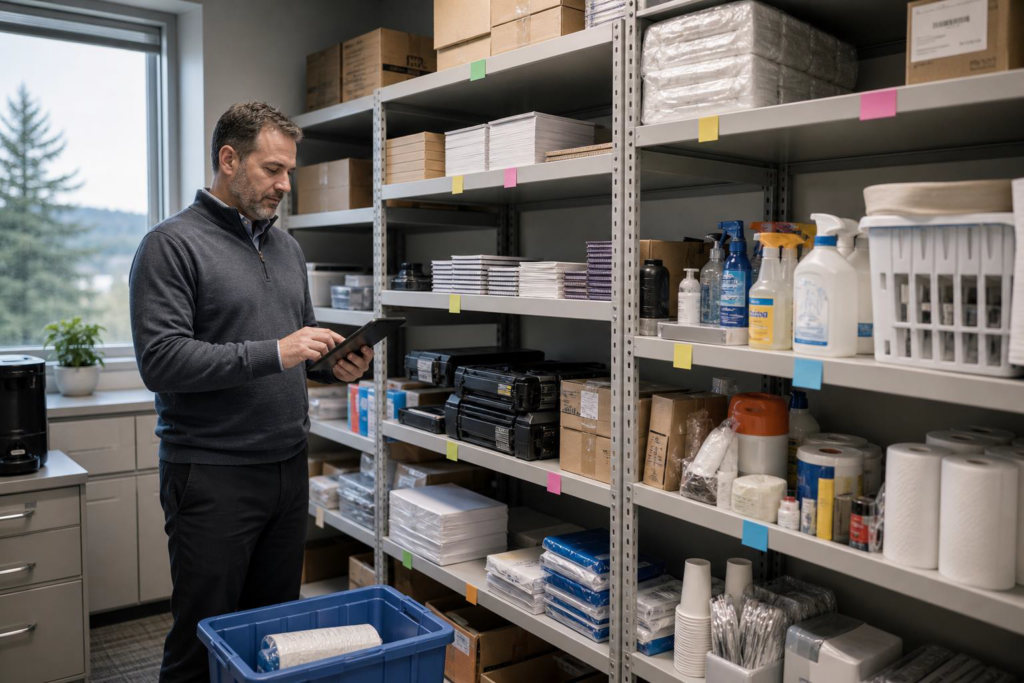
A reorder point tells your team when to buy, based on how fast an item is used and how long replenishment takes.
Start with supplies that can interrupt work:
• Copy paper and toner
• Shipping labels, tape, and mailers
• Restroom and cleaning products
• Breakroom basics
• First-aid and safety items
For each item, record typical weekly use, delivery time, and a small amount of safety stock. Place a visible marker at the reorder level or track it in your purchasing system. Assign one person to review stock on a set schedule.
The schedule matters. A supply room that five people check “when they have time” often has no clear owner.
Reduce the number of ways supplies enter the building
Supply control gets harder when departments buy the same products from different vendors. Orders arrive on different schedules. Product substitutions multiply. Spending records live in several systems.
A primary supplier gives the business one place to review repeat purchases, build standard lists, and plan replenishment. Departments can still have different needs. They don’t need separate buying processes for every routine item.
Keeney’s carries more than 60,000 office products along with breakroom, facility, janitorial, print, furniture, and shipping supplies. Established customers can check availability online, and orders placed by 5:00 p.m. Pacific qualify for next-day delivery under Keeney’s current ordering terms.
Build a supply system that costs less to run
Start with the last item your workplace ran out of. Calculate the staff time, interruptions, fees, and follow-up caused. Then set a reorder point and give one person ownership of the check.
If shortages keep pulling your team away from its work, Keeney’s can help organize your stockrooms, review inventory, and set up a more dependable ordering process.
Contact a Keeney’s specialist to discuss your supply room and ordering needs.